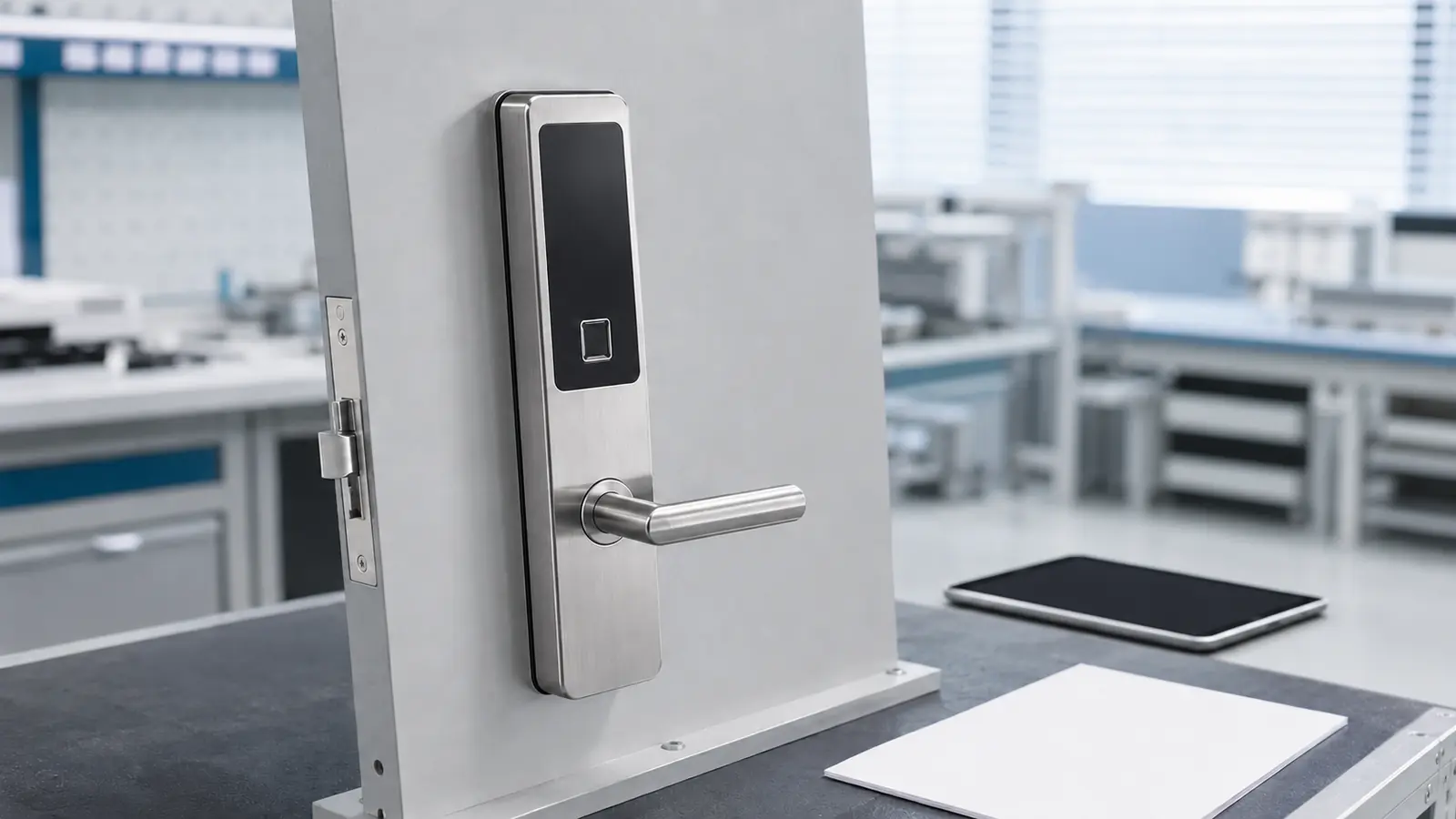
hotel access-control engineer should approve a smart hotel lock manufacturer only when the proposed lock fits the door schedule, works with the credential architecture, behaves predictably during defined offline events, and can be reproduced from sample through production. The technical problem is that a lock may perform well on one demonstration door yet fail when mortises, encoders, cards, software, emergency procedures, packaging, and room-by-room commissioning interact. Feature count is therefore less important than configuration control. The engineer must trace door data and system logic to drawings, samples, test records, and production acceptance. This guide explains the technical evidence, application limits, compatibility checks, and manufacturer records needed to make that approval defensible.
Five Technical Gates Before Manufacturer Approval
The manufacturer should prove five connected points: mechanical compatibility, credential-system compatibility, offline and emergency behavior, repeatable product quality, and project delivery control.
| Approval gate |
Evidence to request |
Why it matters |
| Door and lock-body fit |
Marked door schedule, lock-body drawing, handing rules, cutout dimensions, and approved sample |
Prevents site cutting, exposed holes, latch misalignment, and installation delay |
| Credential workflow |
System diagram covering locks, cards, encoder, management software, room database, and any elevator or access-control interface |
Shows whether the proposed components can execute the hotel’s actual front-desk process |
| Offline and emergency operation |
Written behavior for expired cards, power loss, workstation outage, clock error, mechanical override, and authorized emergency access |
Prevents operational assumptions from becoming security or guest-access failures |
| Sample and batch conformity |
Signed sample record, finish reference, functional test plan, lot identification, and acceptance limits |
Connects the approved configuration to mass production |
| Delivery and support |
Packing map, document list, commissioning responsibility, spare-parts plan, warranty route, and technical contact |
Defines who resolves problems after shipment and during opening |
Why Door Data Must Come Before Lock Selection
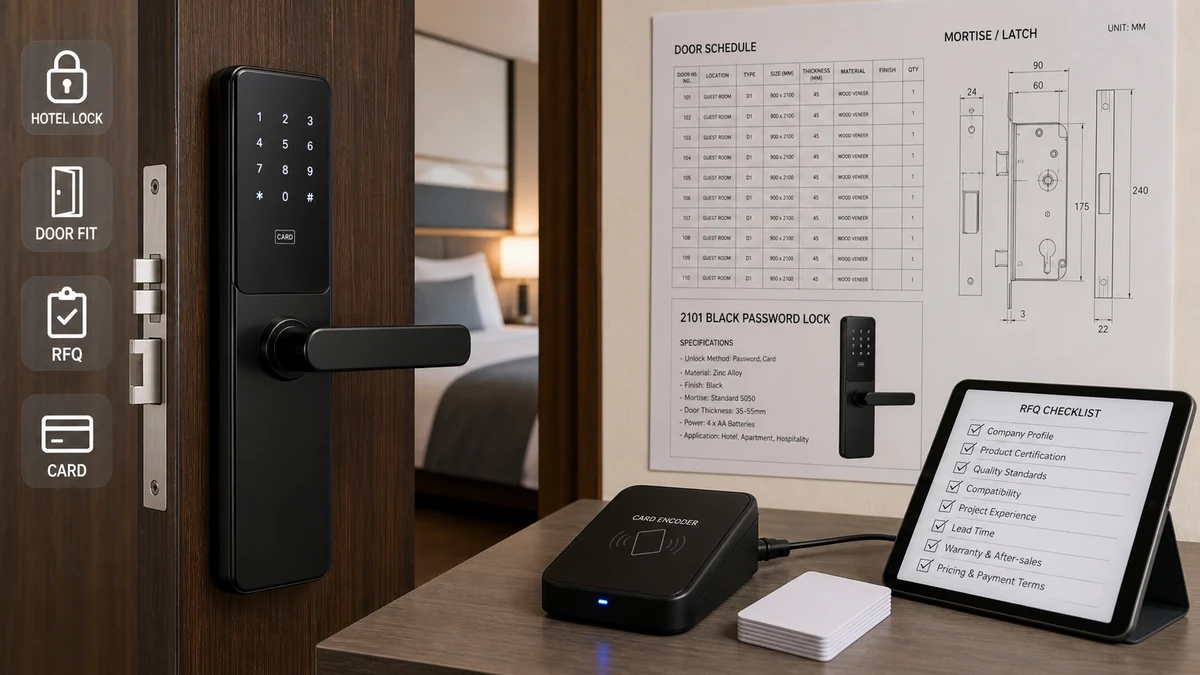
Begin with a door schedule, not a product photograph. For each group, record material, thickness, handing, backset, cutouts, frame condition, latch position, finish, and whether the work is new or retrofit. The supplier should return a marked drawing showing the lock body, spindle, fasteners, mechanical override, relevant cable routing, and installation responsibilities.
Door thickness alone is not enough. Doors of equal thickness can require different lock bodies because the backset, edge profile, existing mortise, trim, or frame alignment differs. Retrofit projects also risk exposed old cutouts and loaded latches.
A Representative Retrofit Scenario
Scenario: Hotel guest-room lock retrofit.
Business Background: A 120-room property groups all guest-room doors under one nominal thickness and approves a lock on a renovated sample room.
Problem: Installation stops when a legacy wing reveals a different mortise cutout, frame condition, and handing mix. The approved lock covers the sample door but exposes old openings and loads the latch on part of the wing.
Cause: The door survey treated thickness as the complete compatibility specification and did not test the worst-case door groups.
Recommended Solution: Separate the schedule by construction, cutout, backset, handing, and frame condition. Fit samples to the highest-risk groups, return marked drawings for approval, and freeze the correct lock-body and packing map before production.
Installation insight: A common project mistake is approving one visually representative door while ignoring the smallest, thickest, most worn, or differently handed door in the property. A useful sample plan tests the worst-case door groups, not only the easiest opening. The manufacturer should identify every unverified dimension as an assumption and state whether field modification could affect appearance, strength, warranty, or commissioning time.
Credential Architecture Is a System, Not a Feature List
A hotel lock is one component in a credential workflow. The technical review should map how reception staff issue, extend, replace, cancel, and audit guest and staff cards. It should also show where the room number, validity period, access level, and system time are written, how data reaches an offline lock, and which records remain available for troubleshooting.
For a project using cards and a key card encoder, ask the manufacturer to demonstrate the complete sequence with the proposed lock, encoder, cards, management software, and room database. If the project also requires elevator control or another access-control interface, define which system grants the permission and who owns integration, configuration, testing, and future support. Similar-looking cards or encoders should not be treated as interchangeable unless the supplier confirms the required technology and system compatibility.
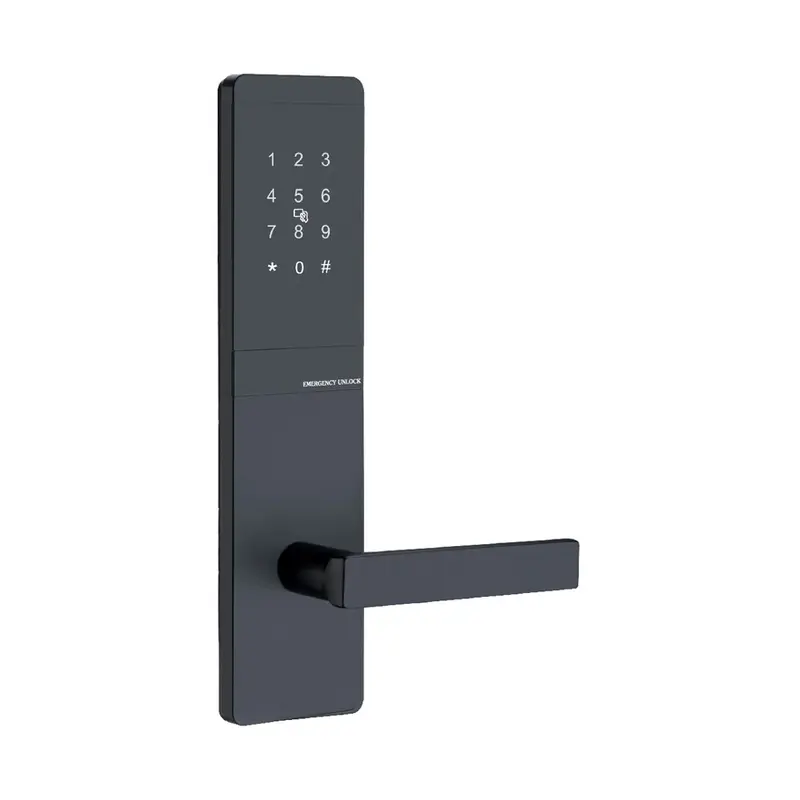
Haolock’s current product data for the 2101 Black Password Lock lists card, key, temporary password, Bluetooth, App, and computer management among the available unlocking or management options for that model. That product evidence can support a configuration discussion, but the buyer should still confirm which functions, accessories, software, and operating modes are included in the exact quotation. A feature appearing in product data is not automatically proof that every project workflow or third-party interface is supported.
Compatibility insight: Buyers sometimes compare lock hardware from one proposal, software from another, and cards from a third as if they were independent commodities. In practice, the credential format, encoder, software version, room database, and lock configuration must be evaluated as one responsibility boundary. Splitting that boundary without a named integrator can create a system in which every component works individually but no party owns the failed transaction.
Why Offline Operation Needs a Written Failure Model
“Offline” must be defined in operational terms. It may mean that room locks do not depend on a live network for each opening, while cards are still issued through a front-desk computer and encoder. It does not mean that time, room mapping, card validity, initialization, audit records, or management procedures are irrelevant. Ask the supplier to explain what information the card carries, what the lock stores, how the lock clock is maintained, and which events require a service card, programming device, or authorized technician.
The project team should create scenarios for workstation outage, encoder failure, expired credentials, lost cards, power or battery problems, room reassignment, staff access, and authorized emergency entry. The review should also cover mechanical egress and override requirements under the applicable building and fire-safety rules. Do not request or document a procedure that bypasses a safety or security control; emergency methods should be limited to authorized staff and aligned with the manufacturer’s instructions and hotel policy.
Operational insight: An emergency feature has little project value if staff cannot locate the controlled key, identify the correct authorization, or follow the procedure during a system outage. Acceptance testing should therefore include the human workflow—roles, records, escalation, and recovery—not just a successful opening at the factory.
The Sample Tests That Expose Project Risk Early
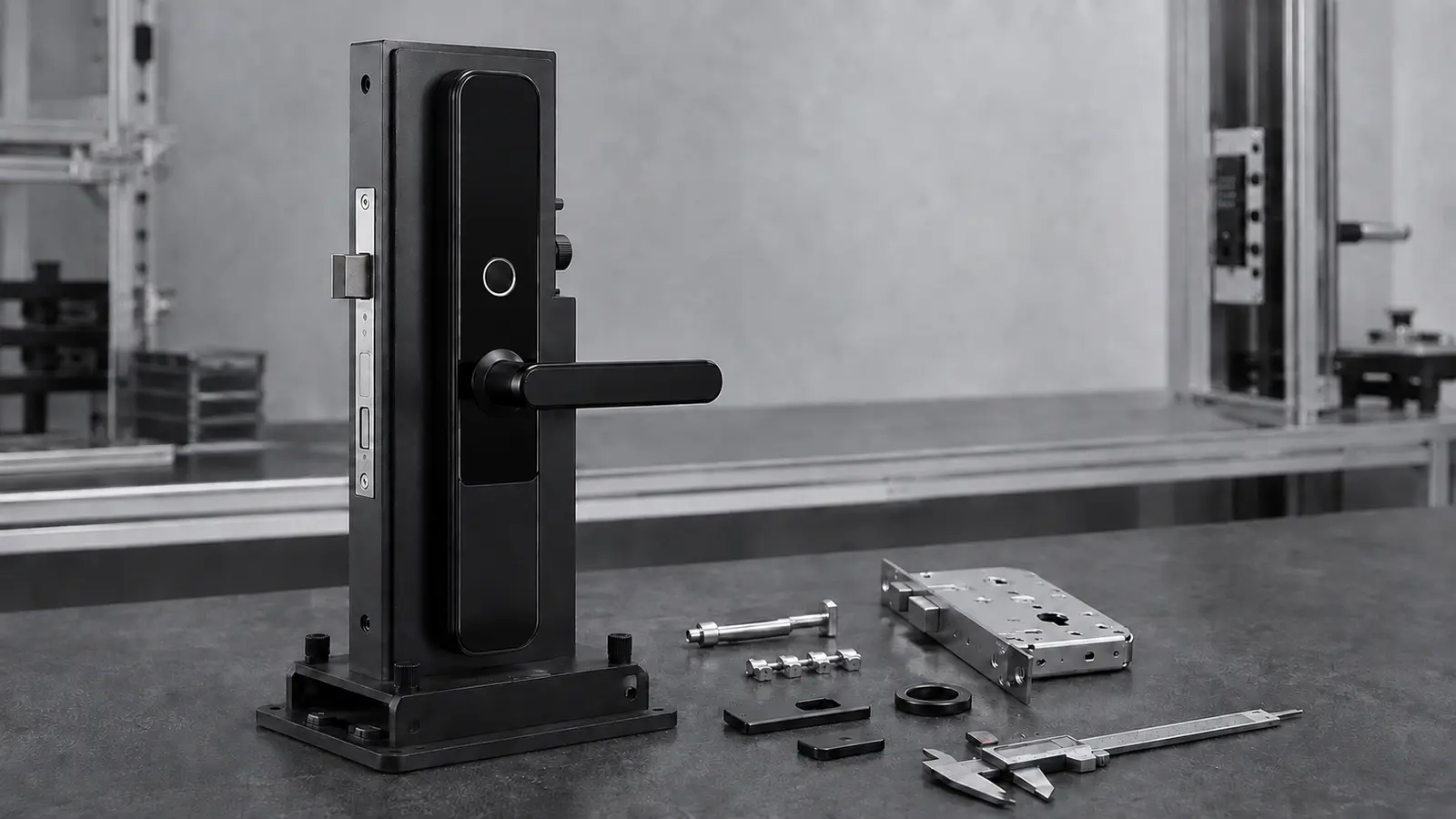
The sample stage should answer questions that drawings cannot. Install the proposed configuration on a representative project door and test closing force, latch engagement, handle return, card reading, authorized and unauthorized credentials, mechanical key operation, battery compartment access, and recovery after an approved fault scenario. Repeat high-frequency front-desk actions such as issuing, extending, replacing, and cancelling cards. Record the lock, encoder, card type, software or management method, lock-body configuration, door data, and test result.
Appearance also needs a physical reference. Confirm material, color, surface treatment, visible texture, logo treatment if requested, handle orientation, and acceptable cosmetic limits under agreed lighting. Screen images are not reliable finish standards. Protective film, separators, accessory bags, labels, and carton layout should be reviewed with the sample because packaging can damage an approved finish or separate a lock from its correct hardware.
Quality insight: A sample can pass because it received extra attention. The stronger approval method defines which characteristics must be reproduced, how the factory will inspect them, and how the buyer will identify the approved revision later. Sign or photograph the approved sample, lock the bill of materials and drawings, and record any deviation that remains open before production.
From Approved Sample to a Traceable Production Batch
Batch acceptance should combine identity checks and functional checks. Identity checks confirm model, finish, handing, lock body, accessory set, labels, documentation, and carton contents. Functional checks confirm the agreed opening methods, latch and handle operation, card reading, key override, encoder pairing, and any project-specific workflow that can reasonably be tested before shipment. The sampling method and acceptance limits should be agreed before production rather than negotiated after a defect is found.
For projects with multiple door groups, the packing map should connect cartons to building, floor, room, door type, finish, and handing where those distinctions matter. This does not require a complicated digital system in every project, but it does require unambiguous labels and a controlled list. Mixing visually similar locks with different mortises or handing can create more site delay than a visible cosmetic defect.
Inspection insight: Counting cartons is not the same as verifying a system shipment. Inspectors should reconcile locks, lock bodies, cards, encoders, keys, installation hardware, software or management items, spare parts, labels, and documents against the approved configuration. A missing encoder or wrong lock-body batch can prevent commissioning even when the lock quantity is correct.
Factory Capability Beyond the Product Sample
A manufacturer review should determine who controls product engineering, purchasing, assembly, programming or configuration, inspection, packaging, documentation, and after-sales support. Haolock’s company profile positions the business as a manufacturer covering research and development, production, sales, and service, with smart locks, electronic locks, hotel locks, access cards, encoders, access control, and elevator-control-related products in its portfolio. Buyers should use this positioning as the basis for questions, then request project-specific evidence.
Ask who approves substitutions, how revision changes are communicated, which tests are performed by lot, and how nonconforming products are segregated. Confirm who provides English technical information, installation guidance, system configuration support, and problem escalation for overseas projects. If a process or component is subcontracted, responsibility should remain explicit; subcontracting is not automatically a weakness, but an undisclosed boundary is a project risk.
Supplier-evaluation insight: Factory photographs and a broad product range do not prove configuration control. A more useful audit selects one sample order line and traces it through drawing revision, material or component identification, assembly instruction, test record, carton label, and shipment document. This exposes whether the supplier can preserve the approved configuration when quantity and product variety increase.
The Commercial Boundaries Engineers Must Flag
Unit price may exclude essential system items or site work. Normalize each proposal for locks, lock bodies, cards, key card encoders, management software or equipment, mechanical keys, access-control or elevator interfaces, installation accessories, spare parts, customization, samples, testing, documents, packaging, freight, commissioning, training, and support. Also clarify whether site door modification, data preparation, room database setup, wiring, third-party integration, travel, taxes, and local compliance activities are excluded.
MOQ and lead time are configuration-dependent and are not stated in the verified source data. Confirm them in the RFQ and separate technical confirmation, sampling, approval, production, inspection, packing, and shipment.
Commercial insight: The lowest lock price can create the highest project exposure when the proposal relies on unpriced assumptions. Ask bidders to return an inclusion-and-exclusion schedule. This makes the cost of cards, encoders, software, customization, replacement stock, packaging, and site support visible before supplier selection.
A Manufacturer RFQ That Engineers Can Defend
An effective RFQ should include:
- Project type, destination, room count, opening schedule, and required delivery stages.
- Door schedule with material, thickness, handing, backset, cutouts, frame condition, and drawings or photographs.
- Required opening and management methods, including cards, encoder workflow, temporary credentials, App or Bluetooth needs, computer management, and authorized mechanical override.
- System boundaries for front-desk equipment, room database, elevator control, access control, installation, commissioning, and training.
- Material, finish, color, logo, packaging, labeling, and room-level packing requirements.
- Sample plan, inspection method, batch tests, acceptance limits, required documents, and change-control process.
- Quantity by configuration, spare-parts expectation, quotation currency and Incoterm, destination, warranty route, and requested support.
Require the supplier to return a compliance matrix instead of a simple “yes.” Each response should be Confirmed, Deviation, Option, Buyer Input Required, or Not Included, with a reference to the offered model or document. This format exposes unresolved decisions while there is still time to change the design or commercial scope.
FAQ
Is a working sample enough to approve a smart hotel lock manufacturer?
No. A sample proves only the tested configuration under the tested conditions. Approval should also cover drawing and bill-of-material control, batch inspection, packaging, labeling, system accessories, documents, change control, and technical support. The production order must remain traceable to the approved sample and revision.
What door information should be sent before requesting a hotel lock quotation?
Send door material, thickness, handing, opening direction, backset, edge and frame details, existing cutouts for retrofit doors, required finish, quantities by door group, and photographs or drawings. The supplier should identify any missing dimension that prevents compatibility confirmation.
Should buyers choose the manufacturer with the most unlocking methods?
Not automatically. Select the methods required by the hotel’s operating workflow and confirm how they work together. Extra features can add accessories, setup steps, training, or support dependencies without solving the project’s main access-control requirement.
How should hotel lock finishes be approved?
Use a physical sample under agreed viewing conditions and document material, color, surface treatment, texture, logo, acceptable cosmetic limits, protective film, and packaging. Digital images can support communication but should not be the sole acceptance reference.
Which certifications should a buyer request?
Request the standards, test reports, declarations, or market documents required for the destination, building, electrical product, radio function where applicable, and project contract. Verify that evidence applies to the exact offered model and configuration. Haolock’s verified client files do not provide a universal certification list, so the article does not claim one.
How should MOQ and lead time be evaluated?
Ask the manufacturer to confirm both for the exact model mix, finish, customization, sample process, documents, inspection, packaging, and delivery plan. Separate sample lead time, approval time, production, inspection, and shipment; do not rely on an unsupported universal figure.
The Engineering Decision
Choosing a smart hotel lock manufacturer is a configuration-control decision. The strongest supplier is not simply the one with an attractive sample or long feature list, but the one that can connect door data, credential workflow, offline behavior, approved appearance, batch testing, packaging, and support to one auditable project scope. A marked door schedule, working system demonstration, controlled sample, inspection plan, and compliance matrix give hotel teams a defensible basis for approval and reduce late installation and commissioning surprises.
Request a Project-Specific Configuration Review
For a technical configuration review, send the door schedule, required credential workflow, room quantities, finish and packaging expectations, system interfaces, sample tests, and destination requirements through Haolock’s contact page. The technical team can use that information to identify a matching lock configuration, list unresolved compatibility points, and prepare a project-specific quotation without treating missing data as confirmed assumptions.