Direct Answer: Smart lock installation cost for a multi-door project changes with door preparation, existing mortise compatibility, lock-body fit, local labor scope, credential or management setup, commissioning, pilot-room testing, travel, training, spares, and rollout sequencing. Buyers should compare quotations by scope rather than hardware price alone and provide a door schedule before asking suppliers for a final project quote.
For hotels, apartments, rental properties, dormitories, and other managed-room projects, the installation quote is rarely just the price of a lock multiplied by the number of doors. The real commercial question is what must happen before each lock can be fitted, configured, tested, handed over, and supported. Haolock supplies smart locks for project-oriented B2B buyers and supports model and configuration confirmation based on door type, unlocking method, management method, and project needs. Buyers can begin with the Smart Lock product range, but installation scope should be defined separately from hardware selection.
Why Is Hardware Price Different From Installed Project Cost?
A hardware quotation answers one question: what does the selected lock package include? An installation quotation answers a much broader question: what work is required to make that lock operate correctly on the buyer's actual doors and within the project's access workflow?
For a new-building project with consistent doors and approved lock preparation, installation may be relatively predictable. A retrofit project can be very different. Existing mortises, hole patterns, door thicknesses, handing, frames, strike positions, damaged doors, non-standard openings, and site restrictions can all change the amount of work required before the lock is ready for use.
| Quote Area | What Buyers Should Confirm | Why It Changes Cost |
|---|
| Lock hardware | Exact model, lock body, handles, accessories, finish, and quantity | Different hardware packages are not directly comparable. |
| Door preparation | Existing openings, drilling, cutting, reinforcement, strike adjustment, and repair | Retrofit work can add more labor than the lock installation itself. |
| Mortise / lock-body fit | Existing mortise dimensions, backset, faceplate, spindle position, and door handing | A mismatch may require door modification or a different lock configuration. |
| Installer scope | Who supplies labor, tools, consumables, supervision, and site access coordination | Supplier, local installer, and buyer scopes can differ significantly. |
| Credential / management setup | Passwords, fingerprints, cards, temporary access, software, issuer or encoder requirements where applicable | Configuration and management scope may be included, optional, or excluded. |
| Commissioning | Functional checks, credential testing, door closing, strike alignment, handover records | Installation is not complete until the door and access workflow are verified. |
| Training and handover | Administrator training, operating instructions, spare handling, maintenance responsibilities | Project handover may require additional time and documentation. |
Which Door Conditions Should Be Surveyed Before Quotation?
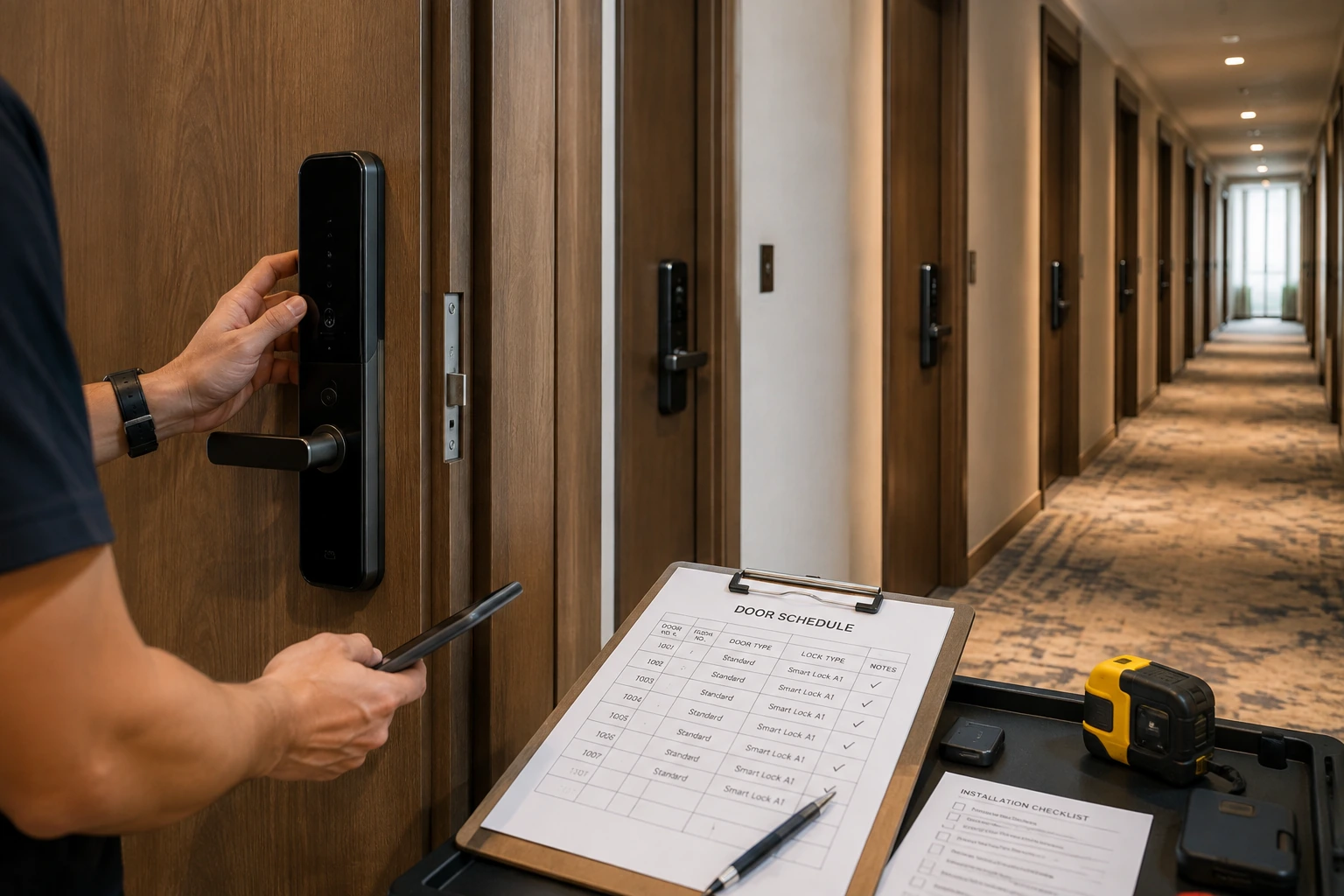
The most useful cost-control step happens before the supplier quotes: create a door schedule. A buyer who sends only the number of rooms and a smart-lock model preference is asking the supplier to make assumptions. Those assumptions may later appear as change orders, site rework, excluded labor, or installation delays.
At minimum, the door survey should record:
- Door material and construction
- Door thickness
- Opening direction and handing
- Existing mortise or lock-body dimensions
- Backset and spindle location where known
- Existing hole pattern and handle position
- Frame and strike condition
- Photos of both door faces and the door edge
- Whether the project is new installation or replacement
- Any fire-door, rated-door, or building-code constraints that the project team must independently confirm
Model dimensions also vary, so one lock family should not be assumed to fit every door in a mixed property. For example, Haolock's product data lists the 1019 Black Password & Fingerprint Lock at 310 × 40 × 20 mm, while the 1021 Black Password & Fingerprint Lock is listed at 325 × 34 × 23 mm. These figures do not by themselves determine door compatibility, but they show why model-specific dimensions must be checked instead of treating all smart locks as interchangeable.
When Does Mortise Compatibility Turn Into Extra Door Work?
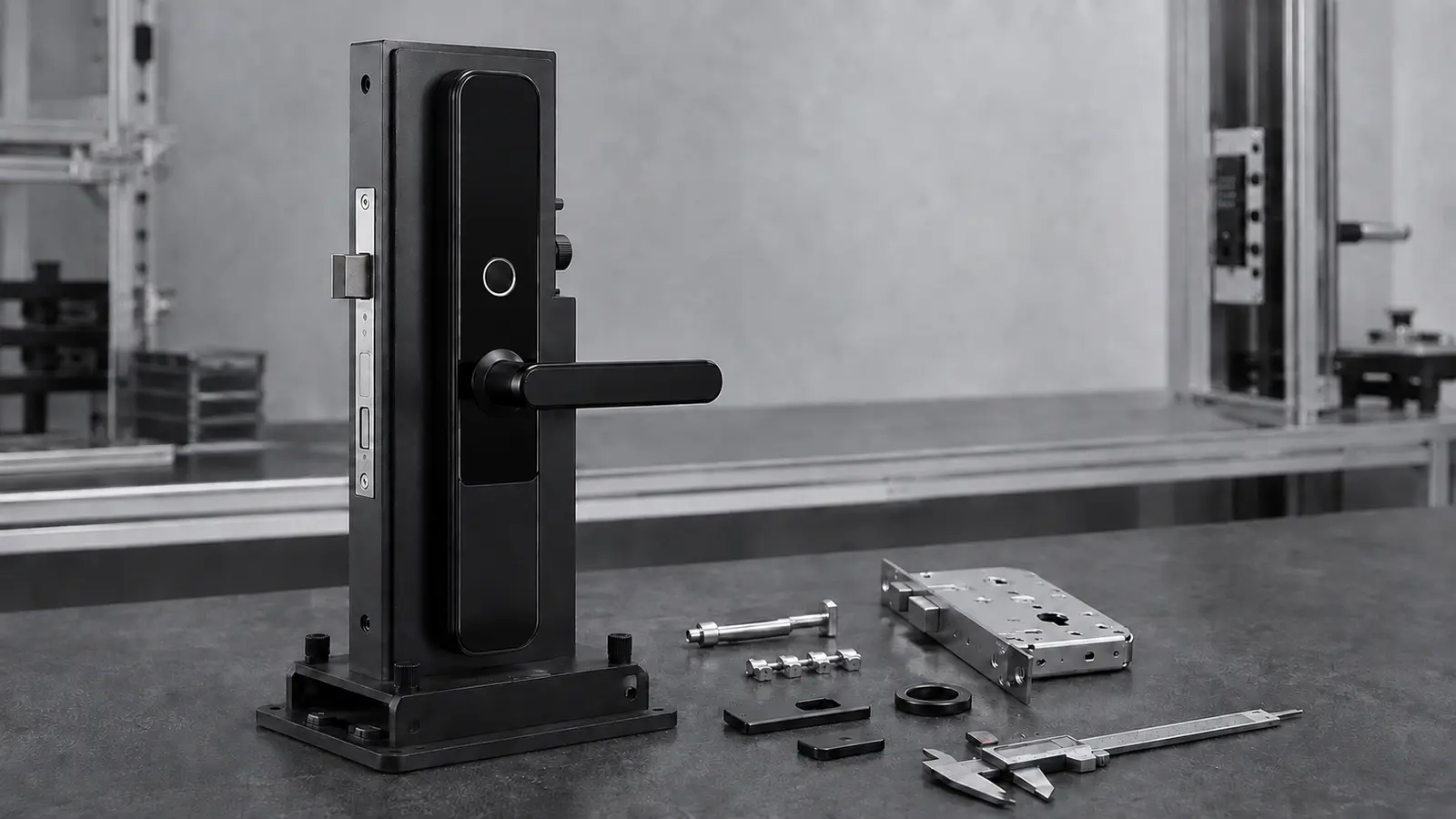
Mortise compatibility is one of the most common reasons a retrofit quote changes after the first site visit. Two locks can look similar from the corridor side while requiring different internal lock bodies, spindle positions, faceplate dimensions, or mounting holes.
A buyer should separate three conditions:
| Door Condition | Typical Scope | Cost Risk |
|---|
| Direct-fit or prepared door | Install the confirmed lock configuration with limited modification | Lower uncertainty when dimensions have been verified |
| Compatible with minor adjustment | Small hole, strike, trim, or alignment work may be required | Labor varies by door condition and installer method |
| Non-matching existing preparation | Mortise replacement, drilling, cutting, cover plates, reinforcement, or door repair may be needed | Hardware price becomes a poor proxy for installed cost |
One practical mistake is assuming that the supplier's lock price includes whatever door modification is needed on site. Another is assuming that the local installer has already priced modification work. A comparable RFQ should state who owns door preparation and how unexpected door conditions will be handled.
Who Should Own Installation Labor and Site Responsibility?
Multi-door projects often involve three parties: the lock supplier, a local installer or contractor, and the property owner or project manager. Cost disputes usually appear when responsibilities are not divided clearly.
| Responsibility | Supplier | Local Installer | Buyer / Project Team |
|---|
| Lock model and configuration confirmation | Usually provides product and configuration information | Confirms installation practicality on site | Provides door and project data |
| Door modification | Must be explicitly included if offered | Often handled locally | Defines approved scope and site rules |
| Mechanical installation | Included only if specifically quoted | Common local responsibility | Coordinates access, schedule, and acceptance |
| Credential / management setup | May provide product-side instructions or project configuration support | May assist with local deployment | Defines administrator and user workflow |
| Commissioning | Scope must be stated | Performs installation-side checks where contracted | Approves test method and handover criteria |
| Training | Must be stated as included, remote, optional, or excluded | May provide local user support | Identifies trainees and operating responsibilities |
The table above is a commercial scope framework, not a statement that every Haolock quotation includes all of these services. Buyers should ask each supplier to mark every line as included, optional, buyer-supplied, local-installer scope, or excluded.
How Do Credential and Management Requirements Change Project Scope?
Haolock's company data shows product options that can include password, fingerprint, swipe card, mechanical key, temporary password, Bluetooth, App, and computer-based management, depending on the specific model and project configuration. The installation quotation should therefore describe the access workflow, not just the preferred unlocking method.
For example, a 20-room serviced apartment may need a different setup from a 300-room hotel. Buyers should define:
- Who creates and removes resident or guest credentials
- Whether cleaners and maintenance staff need separate access
- Whether temporary access is required
- Whether cards, fingerprints, passwords, or a mix are expected
- Whether a card issuer, encoder, management computer, App, or other management tool is required
- Whether configuration is performed centrally, room by room, or by local staff
- Who is responsible for administrator training and handover
The exact functions and management method must be confirmed against the selected model. Buyers should not assume that every smart lock supports every access method or management platform.
Why Should a Pilot Door Be Installed Before the Full Rollout?
A pilot installation is one of the most effective ways to reduce project cost uncertainty. Instead of discovering incompatibility on door 40, the buyer and installer test the selected lock on one or several representative doors before releasing the full installation schedule.
A useful pilot should verify:
- Mechanical fit and required door preparation
- Handle operation and latch engagement
- Strike alignment and reliable closing
- Credential enrollment and access workflow
- Emergency or backup access method
- Installation time under actual site conditions
- Installer tools and consumables
- Finish and appearance against the project sample
- Packaging, labeling, and room-by-room distribution method
- Acceptance checklist for the full rollout
Buyers can also review Haolock's Smart Lock Buying Guide when defining product selection inputs before the installation scope is finalized.
Which Hidden Cost Items Are Commonly Missed?
For B2B projects, hidden cost usually means undefined scope rather than a secret charge. The following items are frequently omitted from early quote comparisons:
- Door modification: drilling, cutting, mortise changes, strike adjustment, patching, reinforcement, or trim plates.
- Site access: restricted work hours, occupied rooms, security procedures, lifts, permits, or phased handover.
- Travel and accommodation: relevant when specialist on-site support is requested.
- Commissioning: testing every lock, credential, door closer, latch, and management workflow.
- Training: property managers, front-desk staff, maintenance staff, or system administrators.
- Spare units and parts: project stock for damage, future replacement, or maintenance.
- Software or management hardware: where the selected system requires separate tools, computers, issuers, encoders, or licenses.
- Rework: caused by inaccurate door data, mixed door conditions, or approving hardware before a pilot.
These are buyer-side scope checks, not universal Haolock charges. A reliable quotation should state which items are included, optional, excluded, or provided locally.
Scenario: Why Can Two Similar Smart Lock Quotes Differ So Much?
Representative scenario — not a claimed customer case.
Business Background: A property operator plans to replace smart locks across 120 apartment doors. The buyer sends room quantity and preferred unlocking methods to two suppliers but does not provide a door schedule.
Problem: Supplier A quotes lock hardware plus standard accessories. Supplier B quotes a broader project package that assumes door survey review, pilot installation support, management setup, commissioning, and training. Supplier B appears significantly more expensive even though the proposed lock category is similar.
Cause: The buyer is comparing different scopes. Neither quotation clearly separates door preparation, local installer labor, commissioning, training, and responsibility for incompatible existing mortises.
Solution: The buyer creates a representative door schedule, confirms the existing mortise and door conditions, defines who performs local labor, selects a pilot quantity, and asks both suppliers to complete the same quotation-scope matrix.
Buyer Decision Value: The revised comparison shows the hardware cost separately from installation and project services, helping the buyer compare equivalent scope and reduce the risk of late-stage installation changes.
How Should Buyers Normalize Smart Lock Installation Quotes?
A like-for-like comparison should use the same scope headings for every supplier. Do not compare one supplier's hardware-only price with another supplier's installed package and conclude that the difference is product price.
| Scope Item | Supplier A | Supplier B | Buyer Decision |
|---|
| Lock hardware | Included / excluded | Included / excluded | Confirm exact model and accessories |
| Mortise / lock body | Included / optional | Included / optional | Match against existing door schedule |
| Door preparation | Included / local scope | Included / local scope | Define drilling, cutting, strike, repair |
| Installation labor | Included / excluded | Included / excluded | Confirm labor location and responsibility |
| Credential / management setup | Included / optional | Included / optional | Confirm exact workflow and model capability |
| Pilot installation | Included / optional | Included / optional | Use representative doors before rollout |
| Commissioning | Included / excluded | Included / excluded | Define test and acceptance records |
| Training | Remote / on-site / excluded | Remote / on-site / excluded | Identify user groups and deliverables |
| Spares | Included / optional | Included / optional | Set project spare quantity separately |
| Travel / site costs | Included / excluded | Included / excluded | Confirm before commercial comparison |
What Should a Multi-Door Installation RFQ Include?
Before requesting a final installation quotation, buyers should provide enough information for the supplier and local installer to define the same project boundary.
| RFQ Input | What to Provide | Why It Matters |
|---|
| Project profile | Hotel, apartment, rental property, dormitory, office, number of doors, renovation or new build | Establishes project scale and operating context |
| Door schedule | Door material, thickness, handing, photos, existing lock dimensions, representative door types | Reduces installation and compatibility assumptions |
| Access workflow | Resident/guest, staff, maintenance, temporary access, administrator roles | Defines credential and management requirements |
| Preferred lock type | Password, fingerprint, swipe card, or combination requirements | Supports model shortlisting |
| Installation responsibility | Supplier, local installer, buyer contractor, or split scope | Prevents labor and door-work gaps |
| Pilot requirement | Representative quantity, test doors, acceptance criteria | Validates fit before full rollout |
| Commissioning | Testing, management setup, handover, documentation, training | Defines when installation is considered complete |
| Commercial inputs | Quantity, delivery batches, destination, packaging, spare units, target schedule | Supports comparable project quotation |
Frequently Asked Questions
What is included in smart lock installation cost?
There is no universal package. Depending on the project, the quotation may include only hardware or may also cover door preparation, lock-body changes, installation labor, credential setup, commissioning, training, travel, and spares. Buyers should ask suppliers to state each item separately.
Why can retrofit smart lock installation cost more than a new-door project?
Retrofit doors can have existing mortises, holes, strikes, thicknesses, and damage that do not match the selected lock. Additional cutting, drilling, cover work, alignment, or repair can increase labor and uncertainty.
Should buyers confirm the mortise before ordering smart locks?
Yes. The existing lock body, door edge, backset, spindle position, handing, and door thickness should be checked before mass ordering. Similar-looking locks do not guarantee direct mechanical interchangeability.
Is a pilot installation necessary for every project?
Not necessarily, but it is especially useful for retrofit, mixed-door, high-quantity, or unfamiliar installation conditions. A pilot can reveal compatibility and workflow problems before they affect the full rollout.
Does a smart lock quotation automatically include software, encoder, or management setup?
No. These items depend on the selected lock and project workflow. Buyers should confirm whether any management software, issuer or encoder hardware, setup, licenses, commissioning, or training are included, optional, or not applicable.
How should buyers compare smart lock suppliers when installation scopes differ?
Use one quotation-scope matrix and require each supplier to mark hardware, door preparation, labor, configuration, pilot support, commissioning, training, spares, travel, packaging, and exclusions. Compare equivalent scope instead of comparing one headline price.
What information should be sent to Haolock for a project quotation?
Send the project type, door count, door photos and dimensions, existing lock or mortise information, preferred unlocking methods, management workflow, finish requirements, pilot quantity, installation responsibility, destination, packaging needs, and rollout schedule.
Request a Comparable Smart Lock Project Quote
Before asking for a final price, prepare a door schedule and divide the project into hardware, door preparation, local labor, access-management setup, pilot testing, commissioning, training, spares, and logistics. Send those inputs through Haolock's Contact Us page. Haolock can review the available smart lock models and project configuration information, while the final installation and site-work scope should be confirmed for the specific project and local conditions.